Miatz Learn & CertifyThe academy is yours.
The academy is yours.
The proof is ours.
Mine your docs into a knowledge graph, score what's broken, regenerate the gaps, and compile a living academy with real exams and Itz'at credentials your customers' AI agents can verify. When the docs change, the academy changes with them.
Their card. Our seam.
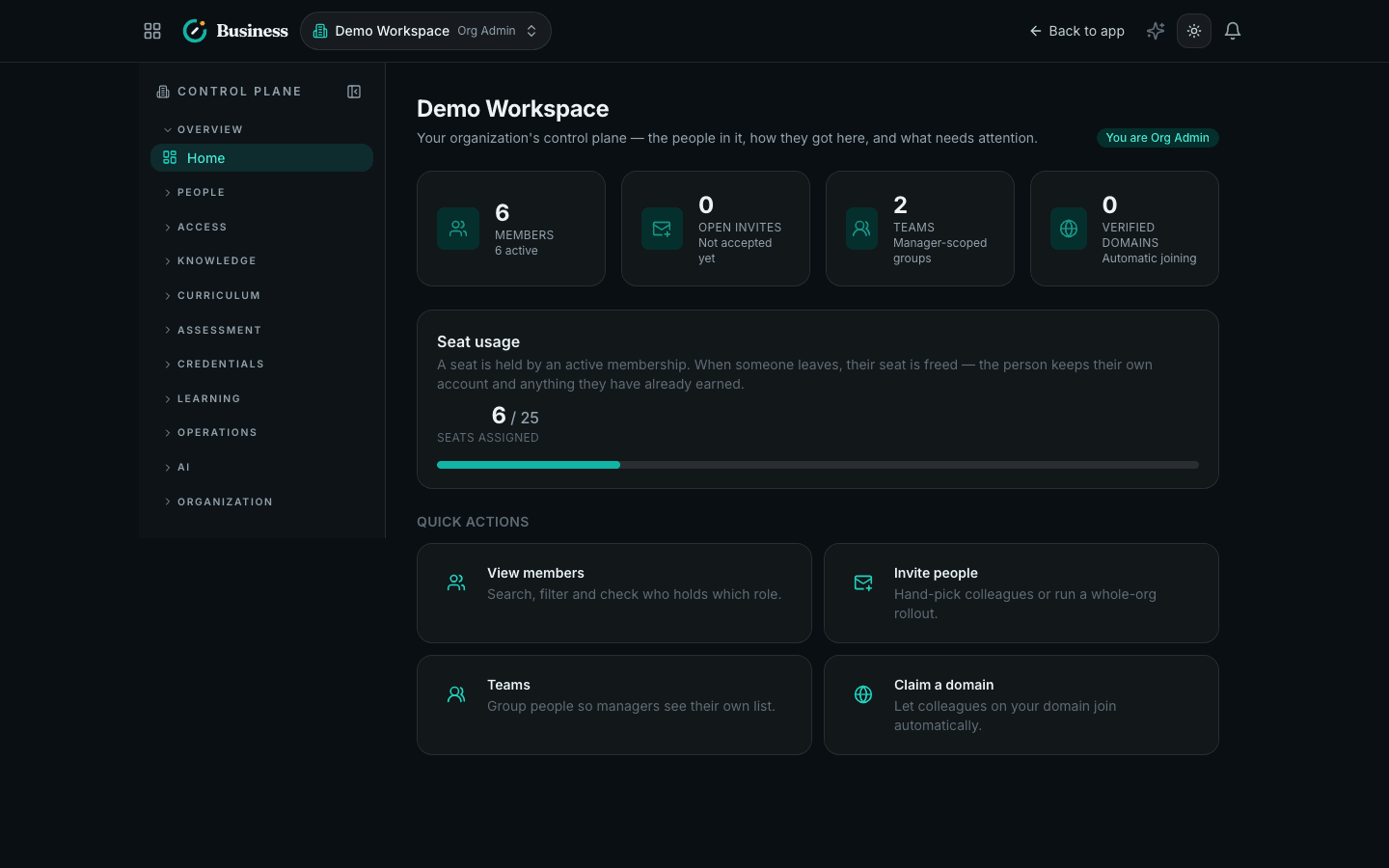
Your console
The console your administrators actually get
Members, roles and module access for your organisation — the same screen your enablement lead opens on day one.
The loop
Seven stages, and the seventh feeds the first
Most learning platforms treat content as an authored artifact you maintain by hand. We treat it as a derived view of your corpus — so drift in the docs shows up as a flagged lesson, a stale exam item and a renewal notice, instead of quietly rotting.
- 01
Ingest
Docs, API specs, repos, tickets — one knowledge graph.
- 02
Score
23 criteria. Per-page defects. A prioritised fix queue.
- 03
Regenerate
Rewrite what fails. You approve every block.
- 04
Compile
Tracks, lessons, labs, quizzes — each one cited.
- 05
Certify
Blueprinted exams. Signed Itz'at credentials.
- 06
Distribute
Static academy, Xook tutor, llms.txt, exports.
- 07
Observe
Answer gaps, decay, renewals — back to stage one.
Stages 1 and 2 are what the free audit runs. Everything after that is opt-in, and nothing publishes without your sign-off.
The white-label boundary
Yours to control. Never restylable.
The line is the product: everything about the learning experience is yours; everything that makes the proof credible is sealed.
Yours to control
- Colour ramps, radius, one display font
- Logo, favicon, domain, email sender
- Curriculum and the certificate face
- Learner data — gated by an automatic AA-contrast check
Never restylable
- The assurance marks and level codes
- The verification page — never tenant-hosted
- The signing keys and status vocabulary
- The focus ring and the reduced-motion kill switch
YOUR MARKpowered by
Indian data residency
AvailableLearner records, submissions and assessment evidence are stored in India — Supabase's ap-south-1 (Mumbai) region — and the application's server-side compute is pinned to Vercel's bom1, in the same city as the database. Three things necessarily leave the country: AI inference to the model provider serving the request, mobile push through APNs and FCM, and transactional email through Resend. Each is named, with the safeguard relied on, in the Privacy Policy.
A0 – A4
Assurance you can point at
Every credential carries its level, and every level says who checked what.
- A0No markSelf-attested completion; nobody checked.issued by: Any tenant
- A1Assessed on miatzScored against a stored rubric, tamper-evident, signed, machine-verifiable.issued by: Any tenant, automatic
- A2Kanan ProctoredIdentity bound, session attested, anomalies logged and reviewable.issued by: Tenants with a Kanan-certified proctor on record
- A3T'aan DefendedRecorded oral examination on the candidate's own decisions, scored on reasoning.issued by: Tenants on the assessment tier
- A4Itz'atChuun-gated, real work, proctored AND defended.issued by: miatz only — never licensed
The vocabulary is closed — nobody may add a level or reword one. Definitions
You can climb to A3 by buying more assurance. Nobody can buy A4.
What you get
One platform where the market assembles five vendors
LMS, exam delivery, proctoring, badging and a credential registry are usually four contracts and an integration project. Here they share one data model — which is the only reason the loop can close.
Miatz Academy Available
Role-based tracks, lessons, labs and quizzes compiled from your own corpus — every lesson citing the source chunk it came from. Enrollment, cohorts, prerequisites, community spaces, seat management.
Miatz Certify Available
The layer that makes it certification rather than quizzes: item banks with statistics, weighted blueprints, randomised parallel forms, an Angoff-lite cut-score wizard run by your SMEs, retake policy, expiry and renewal.
Miatz Kanan Beta
Proctoring, built in-house. Secured browser and telemetry, then AI monitoring with a sealed evidence locker, a live human proctor console, and Kanan Journey — assessment of real user journeys inside your actual product.
Miatz T'aan Beta
An AI oral viva. Adaptive follow-up questions generated from the exam blueprint, rubric-based scoring, full recording and transcript, human moderation on borderline results. You cannot memorise your way through a conversation.
Xook tutor Available
Academy CMS Available
Your control plane: content tree with draft → review → publish, block editor, brand theming, navigation and glossary editors, exam-policy and journey designers, roles, audit log, preview environments, scheduled publishing.
Static delivery Available
Every academy publishes as a static bundle on your own domain — sitemaps, schema, llms.txt and a .md mirror per page, so an answer engine or an agent reads what a page says without executing a line of JavaScript.
Tenant MCP server Coming soon
A per-tenant MCP server over your own academy — search your docs, fetch your catalogue — is not built. What runs today is ours: a public MCP server anyone can add with no account, and a credentialed one over the QA machine layer.
War-room drills Beta
Scenarios mined from your runbooks, postmortems and status-page history: role cards, timed tabletop exercises run by an AI game-master, runbook-linked remediation, scored. Drill logs are auditable evidence.
AI Fluency & Tuukul Available
Judgment at Scale: coach your people in the flow of their real AI work, measure calibration and verification discipline (never their prompts), and see team readiness as aggregate rollups — coach, not cop.
The Itz'at standard
Verifiable without trusting us
An Itz'at is an Open Badges 3.0 credential, which is a W3C Verifiable Credential 2.0 — signed with Ed25519 and revocable through a public status list. The design goal is verification that does not depend on a miatz server; the key-custody and mirroring commitments that make that a guarantee are being formalised, and we won't claim them until they are written down.
01
Your brand issues it
Onboarding provisions an Ed25519 keypair in a KMS and publishes a DID document under a domain you control. The issuer on every credential is you — miatz operates the signing service, and never holds keys in an app server or a browser.
02
Miatz co-signs the issuer
Alongside your credential, miatz issues an EndorsementCredential — a native Open Badges construct — attesting that you are a verified Itz'at member: identity checked, exam scheme reviewed, integrity tier disclosed. That is what makes the mark provable rather than decorative.
03
Anyone checks two signatures
A verifier — a human on a hosted page, or an agent calling the open verifier over plain HTTP — checks yours for authorship and ours for the Itz'at mark, then reads the status list for revocation and expiry. Flipping one bit revokes.
Tenant signature
did:web under your domain — authorship
Miatz endorsement
EndorsementCredential — the Itz'at mark
Itz'at · Verified by miatz
Non-removable on every verify page, link, QR and PDF
The honest limit: this is a product-and-skills credential, not accreditation. It is not a degree, a diploma or a licence, and standards conformance is not the same thing as an industry deciding your certification matters. What the standards buy you is that no one has to trust us — or you — to check that a credential is real. How the Itz'at works.
Proof
We run miatz on it first
Our first design-partner customer is onboarding its properties onto this platform as tenants, in order; our own surfaces come first. Nothing here is live yet, and we would rather show you the rollout honestly than a deck of logos.
miatz.comIn build
Tenant #1 — miatz's own learning and credential surfaces are the first onto this engine.
finocket.comIn build
Real developer APIs — the flagship for a Finocket Certified Developer track.
ashr.workQueued
A rating and leaderboard property — same engine, different audience.
demystipai.comQueued
The AI platform Xook itself runs on.
arkivo.aiQueued
Archival and knowledge tooling.
JewellersQueued
A jewellers vertical — a non-developer audience test.
FleetonomicsQueued
Fleet operations — field teams and partner networks.
These are our own properties, not customer logos, and we label the rollout status rather than implying they're all live. A wall of logos you can't check is worth nothing.
Miatz Index
A public benchmark for how well a company teaches itself
Above the corpus-level Docs Score sits a company-level index across five pillars. The methodology gets published before the leaderboard does — and scored companies get a right of reply.
01
Customer education
Academy presence, content freshness, path coverage, certification rigour.
02
Internal enablement
Employee, support and CSM readiness — assessed privately, never scraped.
03
Developer connectivity
Reference completeness, sandboxes, error catalogues, changelogs.
04
AI & agent connectivity
MCP endpoints, llms.txt and .md mirrors, answer-engine visibility.
05
Representation consistency
Do docs, academy, marketing and AI surfaces tell the same story?
Not yet
The leaderboard
No rankings are published yet, so there is nothing here to show you. When it launches it scores public materials only — public docs, public academies, public APIs, public MCP endpoints. Never anything behind a login.
Who you teach
Employees, partners, customers — one platform
The same corpus, compiled into different tracks for different audiences, with separate exams, separate credentials and separate analytics.
Employees
Onboard a selected group or a whole cohort onto a new product, a migration or a practice. Readiness by competency, not completion percentages.
Partners
Certified-headcount rules that partner tiers can be written against, with credential status syncing to your CRM as the automation signal.
Customers
A free learning layer and a paid credential ladder on your own domain — the education-led growth motion, with the exam bank kept honest by your docs.
Questions
What people ask before they start
What does it cost?
Pricing isn't published, and the pricing page says the same thing — the academy rung is quoted on your scope, not listed. We're scoping the first engagements individually so the packaging matches what customers actually use rather than what we guessed. Talk to us and we'll put a number on your scope; the Docs Score audit itself is free either way.
Do we have to move our documentation to miatz?
No. Regenerated content can export back to your repo as markdown or a pull request, or live on a miatz-hosted academy — your choice. We improve your docs; we don't hold them hostage.
Is the Itz'at credential accredited?
No, and we won't imply otherwise. Itz'at is a product-and-skills credential built on Open Badges 3.0 and W3C Verifiable Credentials 2.0. It is not a degree, not a diploma and not a licence. What it gives you is cryptographic verifiability, revocation, expiry and portability — the things a PDF certificate cannot do.
Who owns the content and the credentials?
You own the corpus, the compiled content and the issuer identity — credentials are issued under your own did:web, so your brand is the issuer and miatz operates the machinery. Learners keep their credential permanently, including after they leave your programme or their employer.
What happens to our credentials if miatz disappears?
The design goal is that they still verify: an Itz'at is a signed credential checked against a DID document and a public status list, so verification shouldn't need a miatz API call. The honest caveat: the key-custody and long-term mirroring commitments that turn that design into a guarantee are still being formalised — until they're written down and published, treat this as architecture, not a promise.
How long until an academy is live?
Days rather than quarters is the target, because the content is compiled from material you already wrote instead of authored from scratch. The honest variable is your corpus: if the Docs Score comes back low, regeneration and SME review are the long pole, not the platform.
Can we run miatz-compiled content in the LMS we already have?
Not yet, and we would rather you heard that here than discovered it in implementation. What exists today is an internal activity log kept in the xAPI statement shape, which our own app writes so your dashboards have something real to count. It is not a Learning Record Store: your authoring tools cannot post statements to it, and there is no xAPI read endpoint to pull them out of. SCORM 1.2/2004 and cmi5 packaging, QTI 3.0 item banks and an LTI 1.3 provider are all roadmap rather than shipping. If running inside your existing LMS is a requirement rather than a preference, say so in the first conversation — it changes the sequence, and we would rather scope it than imply it is already there.
Where is our data stored?
In India. The database, authentication and file storage run in Supabase's ap-south-1 (Mumbai) region, and server-side compute is pinned to Vercel's bom1 region beside it. What leaves the country is limited and listed: AI inference to the model provider serving the request, mobile push through Apple APNs and Google FCM, and transactional email through Resend. The Privacy Policy names each transfer and the safeguard we rely on for it.
How is AI-generated content kept from embarrassing us?
Nothing publishes without a subject-matter expert approving it. Regeneration produces a diff view with block-level approve and reject, every lesson cites the source chunk it was derived from, and terminology is enforced against your glossary. The review gate is mandatory, not a setting.
Explore miatz
More from miatz
Start with the free audit
Paste a docs URL and we'll score it against the published rubric — per-page defects and a prioritised fix queue. Useful on its own, whether or not you ever build an academy with us.